
Two Projects, One Mission: Exploring the Hidden Microbial Dynamics of the Swedish West Coast
The recent cruise on R/V Svea combined two complementary projects with one common goal: to better understand the marine ecosystems along the Swedish West Coast. By studying everything from oxygen loss and sedimentary archives to marine microorganisms, the teams hope to reveal how these waters are changing—and what that means for the future of our climate and biotechnology.
What is the main goal of this cruise, and what kinds of data are you collecting?
“We are bringing together two complementary projects along the Swedish West Coast. With our consortium of nine research groups, we aim to better understand how the loss of oxygen in marine systems affects biogeochemical cycles. We focus on both chemical and biological processes, studying modern water columns as well as past coastal systems using sedimentary archives,” says Eric Capo, Umeå University, cruise leader, PI of the biox project.
“In the EcoAct project, we aim to provide new knowledge about marine microorganisms, especially marine Actinomycetota. For this, we study their biodiversity and ecophysiology using seawater, plankton nets, and sediment samples collected from coastal and offshore stations at the Swedish West Coast,” says Carina Bunse, University of Gothenburg, cruise leader, PI of the EcoAct project.
To collect this data, what instruments are you using?
Eric Capo: “For water column, we used a CTR Rosette sampler to collect water samples at different depths and measured some environmental parameters such as temperature, salinity, oxygen etc. For sediment, we used a Gemax corer to take 1-meter-long core, and then a gravity corer that can take 6-meter-long core. With this approach we can study both the changes in the fjords over the past centuries and the past millennia.”
Carina Bunse: “Further, we used a plankton nets and microscopic imaging instruments, so that we could generate near-real time images of marine phytoplankton and microzooplankton.”
What’s a typical day like onboard for the research team?
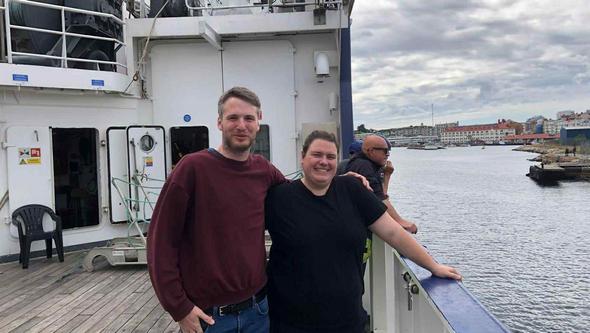
Eric Capo: “Every day we started at 8 am with the first Rosette cast in the water column. Different teams worked on collecting the water obtained, while other teams where handling samples. It was a lot of post-sampling sample processing.”
Carina Bunse: “Some team members would continue filtering waters, subsampling sediments or doing experiments long into the night. It was the same for all of us.”
Did you encounter any surprising findings or challenges during the cruise?
Carina Bunse: “For me it is too early to say. We need to do a lot of post-processing of the samples, and it will take several months for us to get the results. But the cruise went very smooth such that we did not encounter major challenges.”
Eric Capo: “Yes, we did! We expected that the fjord water columns to have a bit less oxygen, but most of the time it showed above hypoxic conditions (>2 mg O2/L). That is good news for the ecosystem, but less for answering our research questions. Luckily, we caught hypoxic conditions at station 19 that was the furthest site in the inner fjord of Idefjorden. Sediment samples from this fjord has preserved the transition of the fjord from oxygenated to euxinic in the 1940s then back to re-oxygenated after the 1970s exceptionally well!
Why is this research important, and how might it impact people and/or the planet?
Eric Capo: “Deoxygenation of marine and freshwater ecosystems is one of the ongoing consequences of climate warming and local human activities such as in the Baltic Sea. This process increasing niches for microorganisms to produce greenhouse gases but also pollutants such as methylmercury. This is crucial for us to better understand what is happening in these ecosystems to predict what will be our future but also inform politicians about the need to counteract this dramatic change.”
Carina Bunse: “Actinomycetota and their biological products are widely used for pharmaceutical applications such as antibiotics, yet their ecological role in the marine environment is less known. Our goal is to study the ecology of these bacteria in their natural environment and provide a better understanding to aid biotechnological research efforts.”
6. What’s one thing you wish more people understood about marine research?
Carina Bunse: “For me, it is that there is only so much we can learn about the ocean from land. Seagoing expeditions, such as this one, are imperative to study the ecophysiology of marine microorganisms and their impact on our planet.”
Eric Capo: “Microorganisms are important in marine ecosystems and need to be more studied to fully comprehend their role in global change.”
What’s the most challenging part of doing science at sea?
Carina Bunse: “It can be a challenge to keep everybody happy, engaged, and focused when we are facing long workdays, rough weather, and change of plans or sampling schedules. However, the Svea crew took very good care of us with fantastic food and smooth communication so that we could focus our energy on the work tasks at hand that lead to many samples for further processing.”
Eric Capo: “From my side, I would say that it is the long days. Filtering water at 3 am can be fun but also challenging when there is another shift starting at 8. At this specific cruise the most challenging part as the expedition leader was to make the right decision about the sampling approach so each team could get samples that are relevant with them.”
What has receiving the SWERVE funding and ship time meant for you? (For example, the opportunity to carry out this research, use a different ship, etc.)
Carina Bunse: “This was a fantastic opportunity. This cruise provided training opportunities for students, a unique microbial dataset from the Swedish West Coast and data for ongoing and upcoming projects. The combined cruise on R/V Svea that could accommodate us all further led to new collaborations across several Swedish universities. I am looking forward to our continued collaboration and work with these datasets.”
Eric Capo: “Getting SWERVE ship-time was the highlight of my 2024. First it meant we could collect more data from fjord systems that would fuel the projects of my PhD students and post-doc. Second, being able to create a new collaborative network with research groups from many other Swedish Universities to get a truly holistic view of fjord systems is a good step forward for the future to produce the type of datasets that will provide new knowledge about changing marine ecosystems. Third, it will be my first cruise as cruise leader and I am very happy to learn this new type of skills.”
Project leader Carina Bunse, cruise leader, PI of the EcoAct project
Affiliation: University of Gothenburg
Research Vessel: RV Svea
Topic: Ecophysiology of marine Actinomycetota
Project leader: Eric Capo, cruise leader, PI of the biox project
Affiliation: Umeå University
Research Vessel: RV Svea
Topic: Biogeochemistry and microbial ecology of fjord ecosystems